The Tata Nano was a revolution that captured the world’s imagination, aiming to mobilize millions of Indian families. While its combustion engine story had a complex ending, its legacy remains powerful. Now, rumors are swirling about a potential phoenix-like rise from the ashes: the Tata Nano Electric 2025. Could Tata Motors be planning to reinvent its most iconic nameplate for the electric age? Here’s what a modern electric Nano could look like.
A Design Reborn: From Minimalist to Modern
The original Nano’s design was dictated by an unprecedented cost target. A 2025 electric version would be a complete reimagining, but would likely honor the original philosophy of simplicity and efficiency.
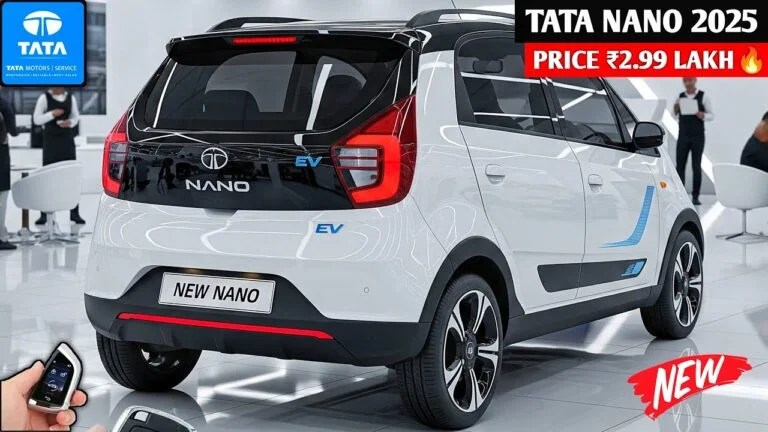
Think of a compact, tall-boy design that maximizes interior space within a tiny footprint. It could feature a friendly, modern face with sleek LED DRLs, a closed-off grille signifying its EV nature, and bold wheel arches to give it a robust, micro-SUV stance. The focus would remain on incredible maneuverability and ease of parking in dense urban environments.
The Electric Heart: Zippy City Performance
The core of the new Nano would be a compact, efficient electric powertrain designed for one purpose: dominating city commutes.
- Range & Battery: Expect a modest 15-20 kWh battery pack offering a real-world range of 150-200 km. This is more than sufficient for daily urban use and would keep the cost down.
- Performance: A small electric motor producing around 40-50 HP would provide zippy acceleration from standstill, making it perfect for cutting through city traffic. The instant torque would make it feel much peppier than its petrol ancestor.
- Charging: It would support standard AC charging, and could potentially offer a DC fast-charging option, allowing the battery to be topped up from 10-80% in under an hour.
Interior: Tech-Savvy and Space-Efficient
The cabin would undergo the most dramatic transformation. The 2025 Nano Electric would shed its minimalist past for a smart, connected, and space-efficient interior.
- Digital Hub: A compact yet modern digital instrument cluster and a large, freestanding touchscreen infotainment system with smartphone connectivity would be central features.
- Maximized Space: Utilizing an EV-specific skateboard platform (likely a derivative of Tata’s gen-Z architecture) would free up incredible interior space, potentially offering a more spacious cabin than many larger cars.
- Essential Features: Expect power steering, air conditioning, and modern upholstery as standard, finally aligning with contemporary expectations.
Safety: A New Standard
The original Nano’s safety was a major criticism. The electric version would be built from the ground up to meet modern global safety standards.
- Strong Structure: A reinforced body shell built with high-strength steel.
- Essential Safety Tech: Dual airbags, ABS with EBD, and rear parking sensors would be non-negotiable standard features, aiming for a solid Global NCAP rating.
The Price & Positioning: The Ultimate Urban EV
The key to its success would be aggressive pricing. Positioned below the Tiago EV, the Tata Nano Electric could aim for a revolutionary price point, making it the most affordable electric car in India.
It wouldn’t have any direct rivals. Instead, it would create a new segment: the ultra-affordable urban micro-EV, competing with electric scooters and higher-end petrol-powered hatchbacks for city dwellers.
Final Verdict: A Dream of Democratic Electrification
The Tata Nano Electric 2025 remains a rumor, but it’s a powerfully compelling one. It represents the perfect full-circle moment: taking a car designed for mobility and transforming it into a symbol of sustainable, accessible mobility for the future.
If Tata Motors can execute this vision—combining the Nano’s iconic value with a practical electric powertrain, modern features, and crucial safety—at a disruptive price, it wouldn’t just be a new car launch; it would be a historic event, potentially electrifying a whole new generation of Indian car buyers.
Leave a Reply